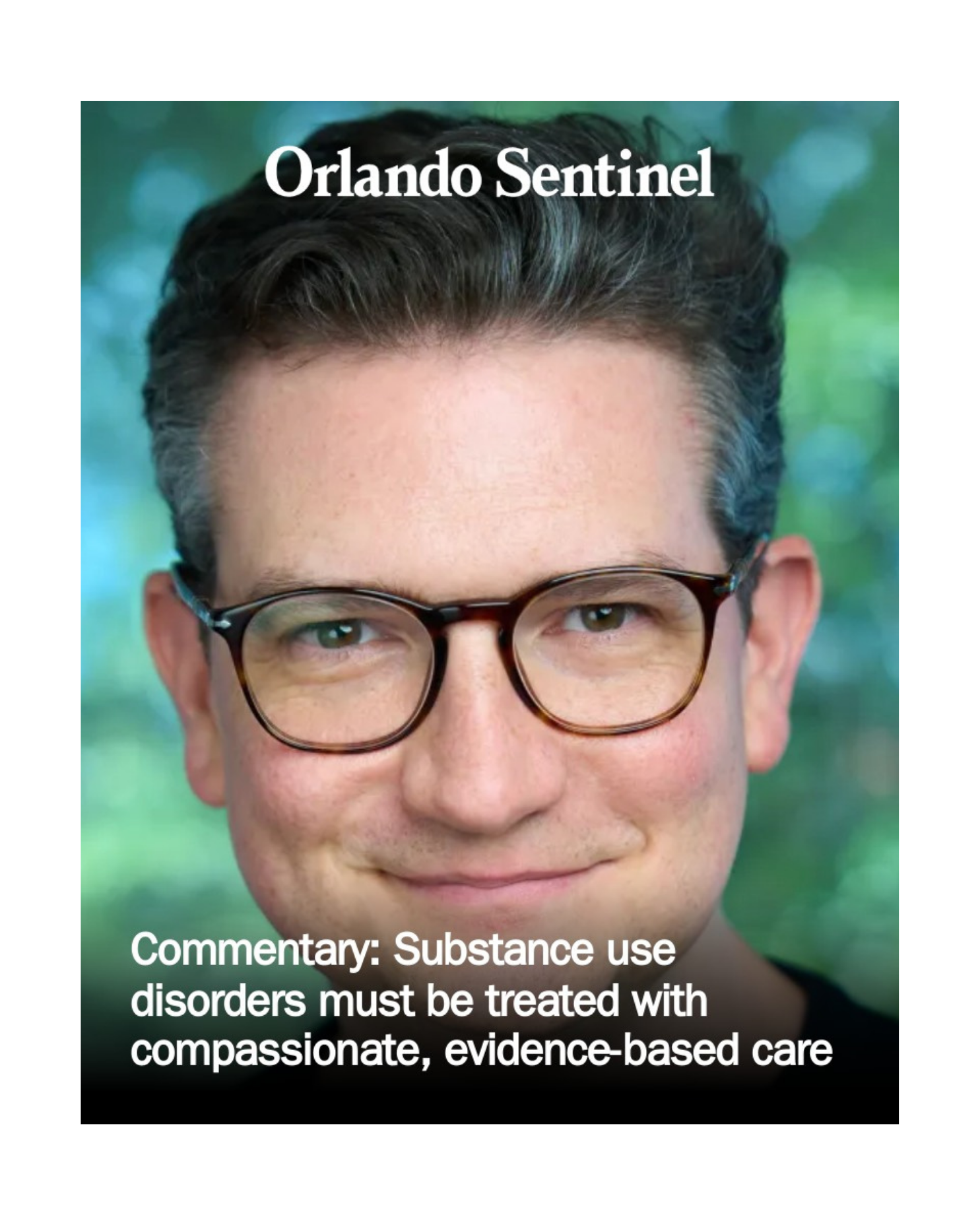
Rethinking Recovery: Why Florida Needs Evidence-Based, Compassionate Care for Problematic Alcohol and Drug Use

When people seek help for problematic alcohol or drug use, the kind of support they receive can make the difference between meaningful, sustained change and staying stuck in patterns that no longer serve them. Yet across the country, evidence-based approaches for addressing these issues are still not the norm. Moving to Orlando aligned with a long-standing professional goal: improving how people receive support for problematic alcohol, drug, and other substance use, and helping people with these challenges across the country by making evidence-based practices the standard.
Substance Use Disorders — the clinical term — are rarely, if ever, isolated concerns. People seeking support often present with overlapping challenges such as anxiety, OCD, depression, trauma histories, chronic stress, or relationship difficulties. Effective care requires more than good intentions; it requires training, supervision, consultation, and ongoing curiosity about culture, context, systemic barriers, and the social determinants of health. This approach mirrors general healthcare, where clinicians rely on evidence, protocols, and ongoing learning to improve outcomes and ensure consistent quality of care.
In Cognitive Behavioral Therapy (CBT), my primary modality, we begin with a simple but essential truth: behavior makes sense in context. People do not repeatedly engage in behaviors that serve no purpose. They repeat behaviors because, at some point, those behaviors worked — they solved a problem or helped them cope with a difficult reality.

What is often labeled as “addiction” is better understood as learned behavior: actions that reduce pain, quiet anxiety, numb trauma, or provide relief from relentless intrusive thoughts and the obsessions that follow. If these behaviors did not offer something meaningful, people would not continue them.
This perspective is not radical.
It is foundational to many evidence-based psychotherapies.
In Unbroken Brain, Maia Szalavitz reframes problematic substance use as a learning and developmental issue rather than a moral failing. In Beyond Addiction, Jeffrey Foote, PhD, Carrie Wilkens, PhD, and Nicole Kosanke, PhD — peers in evidence-based treatment — the authors emphasize the importance of compassion, love and kindness, behavioral principles, and practical strategies for change grounded in science rather than shame. Their work highlights that substance use is often a response to unaddressed mental health challenges, trauma, and unmet needs.
A New Understanding:
SMART Recovery reflects this evidence-based understanding. As a secular program grounded in cognitive-behavioral and motivational approaches, SMART teaches practical tools for managing urges, coping with challenges, and improving quality of life. Importantly, it does not impose a single definition of recovery. People are supported in choosing goals that fit their values — whether harm reduction takes the form of abstinence, moderation, or other meaningful changes that reduce harm and improve functioning.
So why do abstinence-only models remain so prominent? In part, history. Long before psychotherapy, trauma science, or neuroscience were understood, substance use was framed in moral terms: clean or relapsed, success or failure. Binary thinking is simple, emotionally compelling, and often comforting, providing a sense of structure in a world of complexity.
Abstinence works well for some people — particularly those who find structure, identity, or community in abstinence-focused programs. Though it should be noted, these programs do not directly address co-occurring mental health issues and could unintentionally reinforce unhelpful behaviors — a topic for another article. The problem arises when what works for some is treated as the only acceptable path for everyone.
From a harm-reduction and cognitive-behavioral perspective, stopping a behavior alone is rarely sufficient. Co-occurring mental health concerns often drive substance use, and social determinants such as housing stability, employment, access to care, and systemic inequities strongly shape outcomes. What is commonly called “relapse” — what evidence-based clinicians understand as a return to earlier learning — is expected and human. It is part of the process of experimentation, practice, and skill-building.

Ethical, evidence-based care begins with curiosity:
What problem did this behavior solve?
How did it help someone manage their reality?
What skills, supports, or alternatives were unavailable?
How can someone build a meaningful life while tolerating discomfort within personal and systemic realities?
Abstinence can be one form of new learning — a valid and meaningful outcome for many. But it should not be treated as the default starting point, nor the only legitimate destination.
At its core, this conversation is not about labels or programs. It is about compassion, evidence, and supporting people in building fuller, freer lives — in Orlando, across Florida, and hopefully one day throughout the country.
About Dr. Gwilym Roddick
Dr. Gwilym Roddick has over 15 years of experience as a psychotherapist, and has a passion for helping people overcome life's challenges which include mental and physical health issues, to lead fulfilling lives. He is one of a small number of substance use disorder specialists in the United States who can help people with co-occurring OCD and other anxiety disorders.